Democrats rethink transgender sports stance as midterms loom
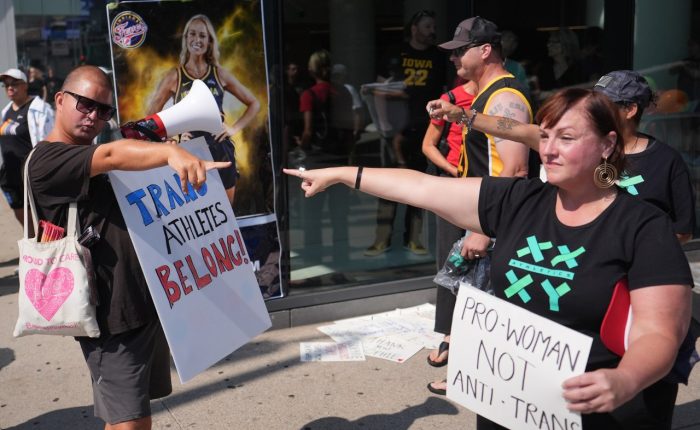
California Gov. Gavin Newsom told The Associated Press he believes it is “deeply unfair” for people assigned male at birth to compete against girls in school sports, placing him largely on the same side as Republican President Donald Trump. The comments from Newsom, considered a leading White House prospect for Democrats, signal a broader party reckoning over transgender policy as the 2026 midterms approach.
While most Democratic officials remain steadfast supporters of the transgender community, an increasing number in red and blue states are distancing themselves from their party’s support for allowing athletes to compete on teams matching their gender identity. The shift follows years of conservative attacks on the issue.
Newsom acknowledged the tension during a recent campaign stop in South Carolina.
“I don’t want to be on that side of it, but I’m being honest , I’d be lying to you if I said differently,” Newsom said. “I haven’t been able to figure out how to make it fair from my perspective.”
The issue was a central theme at the Republican midterm convention in Dallas last week. Trump told the audience he hoped Democrats would not shift their stance.
“I’m petrified that they’ll change,” he said. “That will really hurt us.”
Republicans have begun replaying campaign attacks used against Kamala Harris in 2024, including the phrase “for they/them, not you.” On Friday, they released a new ad targeting James Talarico, the Democratic nominee for Senate in Texas, with that line. A separate America PAC ad backed by billionaire Elon Musk and targeting Democrats in key Senate races in Texas, Ohio and Alaska opens with a clip of Talarico saying “God is nonbinary.”
Talarico began distancing himself months ago and went further in a Fox News interview last week, saying he would vote in favor of a national ban on gender-affirming surgeries for transgender minors.
“I’ve missed the mark on some of my past statements. I will be the first to admit it,” Talarico said in an interview near the Republican convention site. “I think the reason that politicians in that convention center across the street want to talk about six sexes is because they don’t want to talk about $6 diesel.”
In Iowa, Democratic gubernatorial nominee Rob Sand has spoken against transgender athletes competing in women’s sports as a fairness matter. Ohio Democratic gubernatorial nominee Amy Acton has taken a similar position, drawing criticism from the left for adopting Trump’s language after saying she opposed “boys playing in girls’ sports.”
Transgender rights also became a defining issue in Massachusetts’ recent Democratic U.S. Senate primary. Sen. Ed Markey, 80, secured the nomination and credited his win to not shying away from advocating for transgender rights. He used the issue to attack Rep. Seth Moulton, who had said he wouldn’t want his daughters to play against transgender athletes. Moulton apologized for the comments.
According to a June poll from Quinnipiac University, about 7 in 10 registered voters think transgender women and girls should not be allowed to play on women’s and girls’ sports teams. About one-quarter think they should. Democrats are split roughly evenly. A Pew Research Center poll last year found 55% of Democrats were “not too” or “not at all” comfortable with athletes playing on teams that don’t match their sex at birth.
Tyler Hack, executive director of the Christopher Street Project, which works to elect supporters of transgender rights, said the political climate has left many transgender Americans uneasy.
“The reality of being a transgender person in America in 2026 is that on election nights, while other folks are talking about who had a good night and who had a bad night, sometimes you are quietly wondering, ‘Am I going to be OK?’” Hack said.
Independent journalist Erin Reed this month published a guide flagging Democratic candidates she accused of taking anti-transgender positions, highlighting 15 states with such Democrats. She said she would not vote for the “worst offenders” even if it meant a Republican wins.
“One seat can be won back,” Reed wrote. “A party cannot.”
At least 25 states are now enforcing laws or policies banning transgender women and girls from competing in at least some women’s and girls’ sports, with three others having adopted laws blocked by courts. The U.S. Supreme Court earlier this year upheld state laws barring transgender girls from school teams.
NCAA president Charlie Baker testified in 2024 that he knew of fewer than 10 transgender college student-athletes out of more than 500,000 total.
Illinois Gov. JB Pritzker, another potential Democratic presidential contender, has consistently criticized state-level bans on transgender athletes, calling them “bullying” and a “setback for equality.” Following the Supreme Court ruling, he wrote on social media, “There’s a place for you in Illinois.”
Pennsylvania Gov. Josh Shapiro opposes bans on transgender athletes in school sports, calling them cruel and discriminatory, but has also raised fairness concerns.
“Look, I think it’s a tough deal being born into the wrong body. And I don’t think these kids deserve to be persecuted and bullied by the president of the United States,” Shapiro told The Atlantic last year. “I also don’t think they deserve an unfair advantage on the playing field.”
Former Transportation Secretary Pete Buttigieg, who is gay and a potential presidential contender, said earlier this year that he takes seriously both parents concerned about fairness and parents concerned about discrimination.
“But I also have to tell you,” he added, “I would be surprised if this is a top three or even a top 10 voter issue in the midterms this year.”