Supreme Court blocks Trump mail-in voting plan before midterms
The Supreme Court on Monday refused to clear the way for President Trump’s mail-in voting plan for the midterms, keeping intact a lower-court block that declared the plan unlawful. The unsigned ruling came over the dissents of two conservative justices and marks the third time the Trump administration has brought the plan to the high court’s emergency docket.
The court’s brief order said “the Government is unlikely to succeed on the merits of its challenge to the District Court’s preliminary injunction.”
Justice Brett Kavanaugh publicly indicated he voted with the majority. He said he believed there is at least a fair prospect that Trump’s plan is legal.
“But applying the rule in the 2026 elections would be arbitrary and capricious in violation of the Administrative Procedure Act because state and local election officials do not have sufficient time to reasonably implement the rule before the elections,” Kavanaugh wrote.
Justices Clarence Thomas and Samuel Alito publicly dissented.
“Some of the plaintiffs lack standing, while the remainder are pursuing a claim that this Court has recently called a ‘Hail Mary pass’ that ‘rarely succeeds,'” Alito wrote, joined by Thomas.
No other justice publicly disclosed their vote.
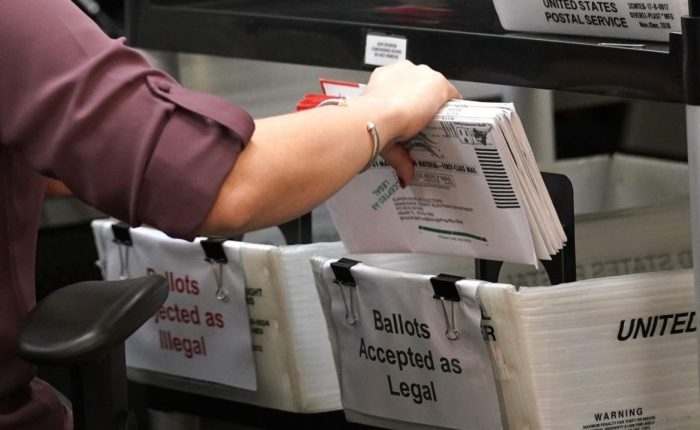
The plan would have required states to upload lists of voters to send them a mail ballot. The Postal Service would also only deliver ballots that meet new design requirements, like an official logo and barcode.
The ruling marked a rare loss for the president on the high court’s emergency docket, which has repeatedly agreed to step in after judges have blocked key aspects of Trump’s agenda.
The mail-in voting lawsuits began after Trump signed a new executive order in March targeting the practice, which he has continually claimed contributes to significant fraud. Election officials have identified limited instances of fraud, but no evidence has emerged suggesting the massive scale Trump has described. The lawsuits claim the plan exceeds Trump’s authority.
Blue states had warned of chaos under the administration’s plan, saying that it would be impossible to comply ahead of November’s contests. Some had suggested it would leave millions unable to vote by mail.
“The efforts that state and local elections officials would have to undertake to even begin an attempt at compliance are herculean,” the states wrote in court filings earlier this week.
Solicitor General D. John Sauer has described the plan as modest, emphasizing that federal immigration authorities aren’t second-guessing states’ mail voter lists. He argued it was well within USPS’s authority to regulate how to handle sensitive mail and called the judge’s block “baseless.”
“Every day that the district court’s injunction remains in place, more ballots are being sent through the U.S. Mail without the benefits that the Rule provides for election integrity,” Sauer wrote in court filings earlier this week.
The case came to the Supreme Court’s emergency docket three times, each after U.S. District Judge Indira Talwani issued a block stopping the president. She is an appointee of former President Obama who serves on the federal trial bench in Boston.
In the first round, which focused on Trump’s original executive order itself, the Supreme Court said the blue states suing likely had no right to sue over it. In August, the Postal Service announced its final plan to implement the president’s directive for the midterms. When Talwani temporarily halted that, the Justice Department brought the case back to the high court. Before the justices ruled, Talwani replaced her block with a new, longer one. Then, the administration filed a third and latest plea at the Supreme Court.
U.S. District Judge Carl Nichols, a Trump appointee who serves in the nation’s capital, blocked Trump’s policy nationwide on Sunday in response to separate challenges. That ruling had not yet reached the justices.