Indonesia expands search for 129 missing in Java Sea ferry sinking
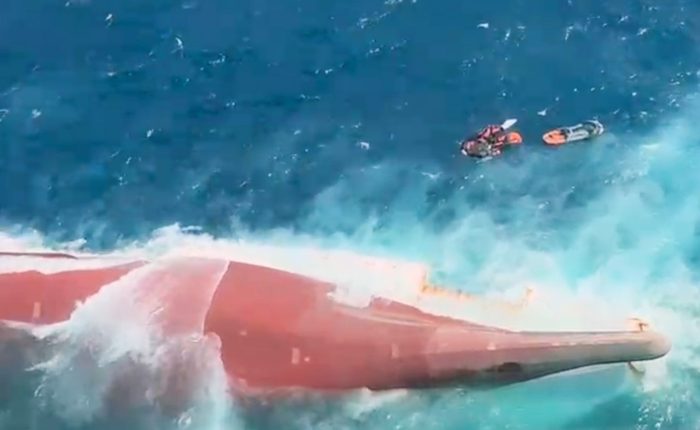
The search for survivors of a capsized ferry in Indonesia intensified Monday as 17 ships and aircraft from the military, police and other agencies were deployed to join the search for 129 people missing in the Java Sea. The vessel overturned Sunday while traveling from Surabaya in East Java province to Banjarmasin in South Kalimantan province.
National Search and Rescue Agency chief Mohammad Syafii said search teams rescued 108 people on Sunday and recovered six bodies. Personnel increased to 655 on Monday.
“We remain hopeful of finding more survivors,” Syafii said in a video briefing.
Authorities deployed specialized underwater teams and underwater thermal drones operated by the navy to strengthen the search effort and speed up the evacuation of victims, Syafii said.
The Virgo Transport 8 was carrying more than 240 people when its captain issued a distress call on Sunday, saying the ship was listing in rough seas with waves of up to 3 meters. Contact was lost at about 2 a.m. Sunday, and about two hours later authorities learned the vessel had overturned in the Java Sea’s Masalembo waters, about 148 kilometers from Banjarmasin.
Videos released by the search and rescue agency after a helicopter search operation Sunday showed the overturned ferry floating in choppy waters.
The manifest said the ship carried 243 people, including 213 passengers and 30 crew members, though it is common in Indonesia for the number of passengers to differ from the manifest. The 119-meter ferry, built in Japan in 1987, was also transporting 89 vehicles.
Authorities have not determined the cause of the accident.
Survivor Ahmad Saudi said the ferry appeared overcrowded, with many passengers forced to sleep in hallways and common areas because the cabins were full. Saudi, a bus driver traveling with a vehicle he was transporting, recalled how the ferry suddenly listed without warning, triggering panic among passengers.
Passengers initially tried to hold on before scrambling to the higher side of the ship as it tilted further, he said, speculating the ferry’s balance may have been affected by trucks loaded on one side.
“The women staying in the economy-class cabins likely didn’t survive because the ferry listed so quickly,” Saudi said. “There were no alarms or announcements warning passengers about what was happening, many people in the cabins may not have had enough time to get out.”
Faisal, another survivor who goes by one name, said he and 14 other passengers clung to a section of the overturned ferry that remained above water after it capsized.
“After the ship listed, people panicked and rushed to the upper deck, but eventually the ferry rolled over completely,” he said. “Fourteen of us were left stranded there.”
The group repeatedly recited the Islamic call to prayer while battling exhaustion and rough seas as they awaited rescue. A wave later swept Faisal toward a lifeboat, helping him survive, he said.
Indonesia is an archipelago of more than 17,000 islands where ferries are a common method of travel and accidents occur regularly, in part due to weak enforcement of safety standards.
Sunday’s accident was the Asia-Pacific region’s third involving a ferry in less than a week. On Sept. 9, a fire onboard a Philippines passenger ferry killed at least 76 people and left 13 missing. On Sept. 11, a ferry sank near Vanuatu, leaving more than 30 people missing.