Lima hosts an aura farming beach battle with costumed dancers
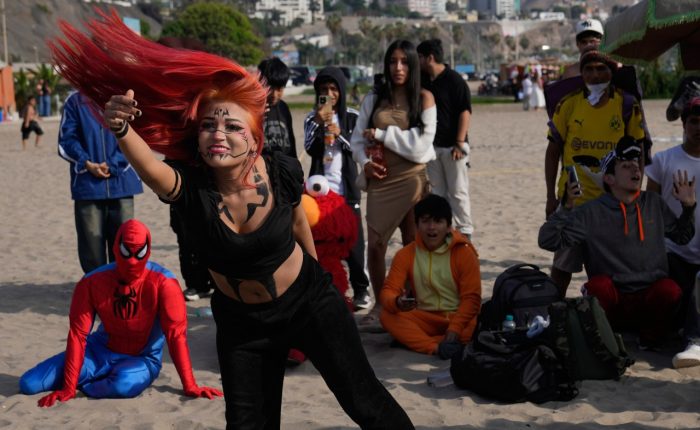
Dozens of young people gathered recently on a beach in Lima to dance and show off their most creative moves in pursuit of what they call aura. The competition, part of a real-world spin on the online trend known as aura farming, drew participants dressed as characters from comic books and animated films.
The event was an “aura battle,” in which competitors vied for the crowd’s applause. Those with the loudest cheers advanced to the next round. One competitor dressed as Spider-Man performed forward rolls and pushups as techno music played. Another hopped on one leg while kicking the other forward.
“Aura farming is about letting your essence flow in a place where people are watching you, but where there is no shame,” said Liam González, a 20-year-old film student who attended dressed as the movie character Shrek.
Gonzalo Cornelio, 19, came dressed as former Venezuelan President Nicolás Maduro, wearing a grey tracksuit like the one worn by the deposed leader the night he was captured by the U.S. military.
Aura farming competitions first emerged in Brazil and spread through social media. Teenagers and adults now hold aura battles across Latin America.
“It’s not about being popular,” said María Paula Martínez, a professor in the arts faculty at Colombia’s Los Andes University. “It’s about showing off good vibes, and having others recognize that.”
Fernando Lícito, a 25-year-old Peruvian content creator, said he saw a video in June of an aura farming contest in Brazil and decided to bring the idea to Peru. He has organized three aura battles there.
“They are simply farming their aura,” Lícito said. “And whoever gets the crowd to make more noise wins.”
Some imitate soccer star Cristiano Ronaldo’s goal celebration, extending their arms downwards and making a sound like “siuu.” Others repeat the words “six, seven” as they move their hands.
Aura battles have spread to cities across Latin America, including Mexico City, Quito and Buenos Aires, where dozens of people staged a battle in front of the Obelisk, one of the most iconic monuments in the Argentine capital. The contests have also reached Spain, with events in Madrid, Burgos and Zaragoza.
Martínez said the concept has moved beyond the digital world into physical spaces, enabling teenagers to socialize.
Some events have faced resistance. In Lima’s Miraflores district, officials recently cancelled an aura farming event, saying they had not obtained the permits required to hold it in a public space.
In July, the mayor of Cuiaba, a city in southwestern Brazil, denied permits for an aura tournament, arguing it was not in the public’s interest. The event was transferred to a university campus.
In Costa Rica, the ministry of education banned aura battles in public schools, arguing they could create conflicts between students or disrupt learning. In Mexico, by contrast, the education minister embraced the trend, posting a video in which he smiles and says he is “farming good education” as the country prepares for the new school year.
González said the hobby gives him a way to have fun and express himself, even if his grandmother doesn’t understand it. “We were born in a different era,” he said.