New Mexico state forester explains how burn scars fuel flooding
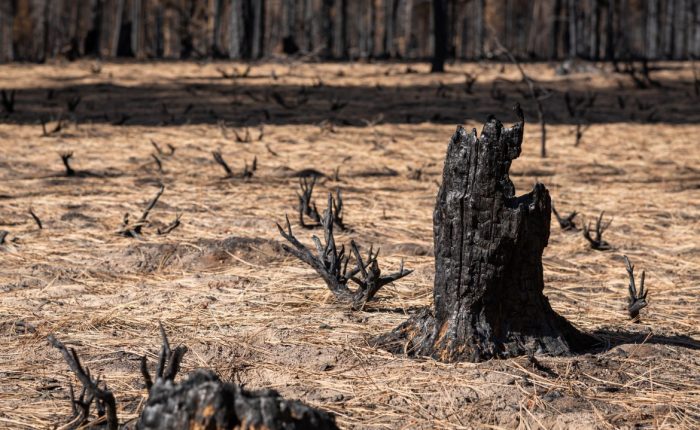
New Mexico’s State Forester Laura McCarthy described how burn scars left behind by wildfires leave the ground unable to absorb rain, sending runoff racing downhill and turning ordinary storms into flash floods. The effect is most severe in the years immediately after a high-severity burn, when ash and the loss of vegetation strip the landscape of the sponge-like qualities that normally slow water down.
McCarthy spoke with KRQE News 13 about the mechanics of burn scars. Her answers, some shortened for clarity, explain why fire-scarred watersheds keep flooding long after flames are out.
Burn scars vary widely, she said. “A burn scar is the area that a wildfire moved through, and we generally think of burn scars as having different levels of severity of burn, ranging from very little impact of a low ground fire, a low severity burn, to a high severity burn where everything can be gone, all living vegetation, and sometimes up to a foot or two of ash.”
She described the low end, where flames “licked around the bases of, say, larger ponderosa pines,” leaving “scorch marks” and “brown needles up above in the tree canopy.” At the high end, “there is really nothing left. You might even see places where there were tree roots, and the roots themselves burned hot, and you’ll see these sort of interesting depressions in the ground where the tree roots got burned out and just completely vaporized.”
Recovery depends on the mix of severities and the timing of rain, she said. “In the areas of high severity burn, you really need to give it some time for the ash and debris to move, and it is rain that’s going to make it move.” She noted that in the Hermit’s Peak Calf Canyon Fire footprint, monsoon rains arrived shortly after the fire and produced greenery by early September.
Replanting, she said, is “very important” and a state priority, but replanting too soon is a mistake. “Depending on the intensity of the rainfall and the frequency, it can be up to seven to ten years until the ground is stabilized enough to make it worth replanting.”
The flooding risk starts with the first rain, McCarthy said. “Initially, the first rainfall, the raindrops are going to encounter a surface that is water repellent. Then the drops are going to start to roll downhill, and they’re going to pick up momentum, and pick up debris, and ash, and start to spiral down and become an actual flow that often happens. Over time, the rain is going to erode into the ash.”
Healthy forests absorb rain in stages, she said. “How forests are actually functioning like a sponge to rain. That when it rains in an unburned forest, first you have the tree canopy, kind of breaking the impact of the raindrops, and then dripping off of the trees. And the water gets absorbed. It percolates down through the soil until it hits bedrock, and then it’s going to flow underground into our streams as beautiful, clear water. All of that’s now gone in a high-severity burn scar. And that’s why we end up with that pretty icky, black water running rampant.”
Asked whether wildfires can re-burn a burn scar, McCarthy said a re-burn “at about 15 to 20 years later can be really destructive, and that’s because there’s enough vegetation in what was the burn scar that it will burn hot, and it can burn so hot that it consumes everything. We’ve seen that in Las Conchas. A significant portion of the Las Conchas fire (2011) was in a 1996 burn scar, and it was very destructive there.”
A short interval can work the other way, she said. “If, say, the weather hadn’t changed in the case of the South Fork and Salt fires (2024), and if one of those two fires had burned into the McBride area (2022), that would have only been two years since that fire had happened, and I believe it would have acted as a buffer and a safe place for firefighters to be able to catch the fire as it came in.”
For residents near new burn scars, McCarthy urged caution. “There are some things that people should be thinking about in regards to burn scars, especially new burn scars, and that is how the debris flow and flooding can be life-threatening.”
She recommended a free app called Watch Duty “that people can download to stay informed and get local updates from the community emergency managers so that they can stay alert.”
Her final warning: “If you see flooding or if you see a scary black cloud over a burn scar, get to higher ground. Don’t take chances. If you’re on a back road, turn around and get yourself to higher ground.”