Albuquerque’s name lost an R, courtesy of a French priest
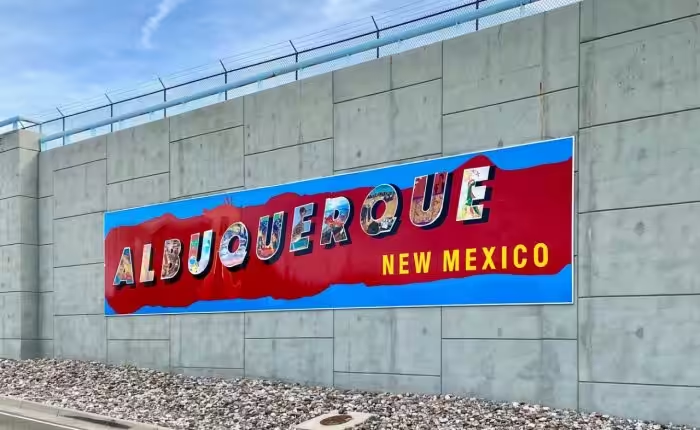
The city of Albuquerque, N.M., has technically carried two spellings since its founding in 1706 by Governor Francisco Cuervo y Valdes. The first, Alburquerque, gave way to the modern spelling, Albuquerque, after a French priest dropped the first R while writing church records.
Cuervo y Valdes, a native of Asturias in Spain and a member of the Military Order of Santiago, named the settlement La Villa de Alburquerque de San Francisco Javier del Bosque, according to New Mexico State Historian Rob Martinez.
The villa honored the Duque de Alburquerque, the then Viceroy of New Spain. Martinez said researchers don’t know exactly how villas were named, but it appears the choice may have had a religious connection.
“San Francisco Xavier is St. Francis Xavier. He was one of the first Jesuits. He was obviously a friend of St. Ignatius of Loyola, San Ignacio de Loyola, the first Jesuit. He established the Jesuits in 1540. So there’s definitely a devotion to that saint at that time in the area. Probably a local priest had something to do with that. Maybe the governor had a devotion to San Francisco Javier. We don’t know, but there’s always that aspect,” Martinez said.
The word at the end of the original name survives in everyday use today.
“…del Bosque, of the forest, because there’s trees along the riverbank, the Rio Grande, the Rio del Norte, as it was known back then,” Martinez said.
La Villa de Alburquerque de San Francisco Javier del Bosque was the third villa in New Mexico, after Santa Fe and Santa Cruz de la Cañada. Martinez said the area was first inhabited by the ancestors of Native Americans who arrived approximately 15,000 years ago.
Martinez said there are different theories as to where the name “Alburquerque” came from, and the same spelling has appeared in different parts of the world, including a town of Alburquerque in the Extremadura region of Spain.
“Some people think it might be of Arabic origin because in Spanish, we have some words like alfombra, almohada, a rug and a pillow. Those are of Arabic origin,” said Martinez. “So Alburquerque sounds like it might have Arabic ancestry. But, the more likely theory is that it’s two Latin words because Spain was also Roman for many centuries. So, albus quercus, white oak. There’s the idea that that’s where the name comes from. And then other people have speculated the word for apricot, albaricoque.”
Martinez tied the spelling change to church records from 1853.
“A French priest in that year started to spell or misspell Alburquerque by taking out the first R. You see it in marriage records, in baptismal records. So that’s where that happens. And then it starts to just take root and gain momentum. So by the time the railroad comes to New Mexico around 1880, we’re seeing it spelled Albuquerque,” Martinez explained.
“I suspect maybe the French priest, maybe couldn’t pronounce it in his French accent, that first R, so he just took it out. And then it just kind of started spreading, being duplicated.”
After the U.S. took control of Albuquerque in 1846 from Mexico, which had acquired it from Spain in 1821, the town officially incorporated in 1885 and was incorporated as a city in 1891.
Two common nicknames used in the city today are “Duke City” and “Burque,” both linked directly to the city’s original name.