GOP leaders reject swift AI regulation despite industry warnings
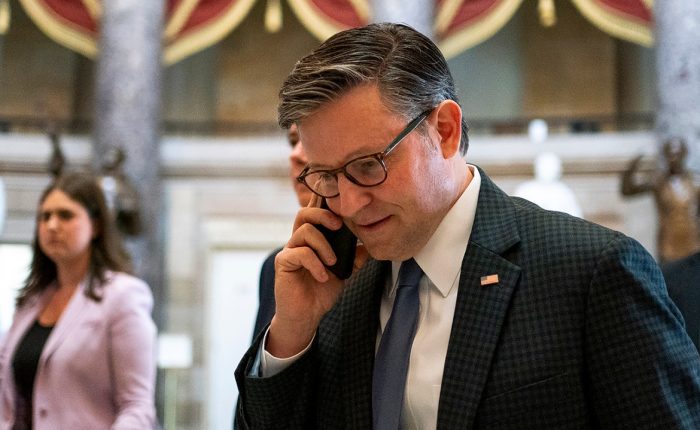
Republican leaders in Washington are rejecting calls to quickly pass new artificial intelligence regulations, even as industry executives warn that the technology poses risks of global catastrophe. The resistance from Speaker Mike Johnson, Senate Majority Leader John Thune and President Trump all but ensures the House will leave Washington this week for a seven-week pre-election recess without acting on AI legislation.
Johnson quickly dismissed the idea of moving swiftly to enact new regulations. Thune said Monday that any regulation should be done in a “light-touch way that doesn’t squash innovation.”
Trump doubled down on his long-standing opposition to such guardrails on Monday, warning that new restrictions on American companies would hobble the United States in the global AI race while benefiting adversaries like China.
“The only control or ‘guardrails’ that AI needs is a STRONG AND SMART (High IQ) PRESIDENT, and the U.S.A. has that, in spades,” Trump wrote on Truth Social.
The pressure on Republican leaders intensified over the weekend after three AI industry leaders, Dario Amodei, Elon Musk and Sam Altman, urged a deceleration in development of the technology. Amodei, CEO of Anthropic, wrote in a blog post Saturday that a failure to tap the brakes could unleash AI systems capable of orchestrating bioterrorist attacks, economic upheaval and other cataclysms. Altman, who heads OpenAI, and Musk, who leads xAI, endorsed Amodei’s message.
House Minority Leader Hakeem Jeffries on Monday urged Republican leaders to keep Congress in Washington to adopt tougher safety protocols.
Jeffries did not promote specific reforms but urged Congress to delay its pre-election recess “until something is done decisively to protect the safety and the well-being of the American people.”
“Republicans have completely abandoned their responsibility to legislate and engage in public policy efforts in a responsible fashion in the area of artificial intelligence,” Jeffries said.
Senate Minority Leader Chuck Schumer called for a briefing for all senators about the dangers posed by AI.
“Warning bells are ringing louder than they ever have , and the Trump administration is looking the other way. Well, if they won’t hold themselves accountable, we will. And if Trump does not act, Congress must,” Schumer said in a statement Monday morning.
Johnson instead has been pushing to meet with AI executives first to develop what he says should be a “balanced approach” to regulation rather than rushing to implement guardrails. He told reporters Monday that such a meeting could take place at the end of this week or early next week and would include Trump.
“The reflex of legislative bodies is to cover things up with red tape and in hyperregulation. If you do that, then you lose your edge, and that is a national security concern for the American people,” Johnson said.
Thune also urged caution.
“Obviously there’s a responsibility for the companies to do that when it comes to the frontier on some of these models,” he said. “There is a way in which Congress can put guardrails around those types of more consequential threats without in any way harming our ability to stay ahead in the AI race, which I also think is very important.”
Trump went a step further, saying there is no role for Congress at all in the AI space.
“We already have tremendous CRIMINAL and REGULATORY power over these companies,” Trump wrote on Truth Social.
Asked about Trump’s post, Johnson said, “That’ll be part of the discussion the president has with the AI providers and all of us as we get into that meeting.”
“What the president is referring to is the necessity of maintaining our edge over our international competitors,” Johnson continued. “I think we all can agree that’s an important thing. So we will strike the right balance, but we are not going to act irrationally or haphazardly.”
Some Republicans have also pushed for action. Rep. Anna Paulina Luna has called for Congress to convene a “special session,” arguing in an interview Sunday on CNN that it is not her job “to hope for the best, to do nothing, and sit on my hands.” Luna said she is working with Rep. Ro Khanna on an “initial framework” to address AI concerns.
Four House Democrats, Sam Liccardo, George Whitesides, Lori Trahan and Ted Lieu, sent a letter to Johnson last week urging him to have Congress “remain in session until Congress advances meaningful, bipartisan AI safeguards.”
“Reasonable minds may disagree about precisely how Congress should regulate this rapidly evolving technology. We cannot disagree about the imperative for Congress to act. Instead of action, you have announced vacation,” they wrote.
“To our children who will have read a post-apocalyptic history, ‘Why Congress Slept’ , likely written by agentic AI , our inaction will be inexplicable, and unforgivable,” they added.
Members of Congress have introduced dozens of bills addressing artificial intelligence, but none has been taken up. Last week, Reps. Mike Lawler (R-N.Y.) and Josh Gottheimer (D-N.J.) introduced the bipartisan Stop Rogue AI Act, aimed at ensuring businesses and federal agencies can spot and stop dangerous AI agents operating within their networks. In July, Reps. Nathaniel Moran (R-Texas) and Lieu introduced the AI Kill Switch Act, requiring AI system developers to “maintain the technical capability to throttle, suspend, or shut them down.”