State forester explains how New Mexico burn scars drive flooding
New Mexico’s State Forester Laura McCarthy explained how burn scars left behind by wildfires make flash flooding more likely and more dangerous. Recent fires in Ruidoso and the older Hermit’s Peak/Calf Canyon scar near Las Vegas have shown how rapidly runoff can turn into destructive floods when rain falls on scorched ground.
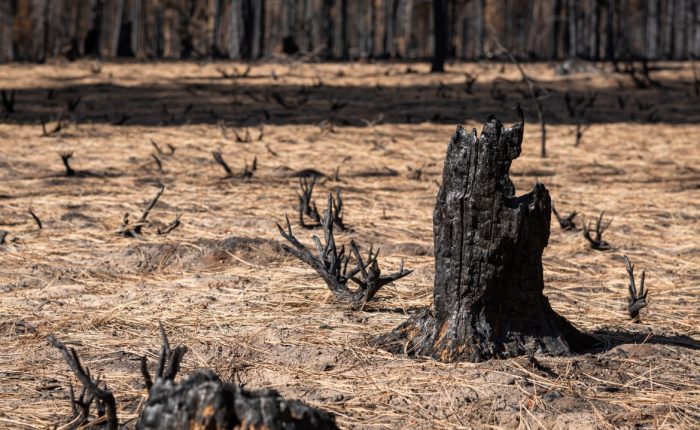
Burn scars are the areas a wildfire moves through, and they range from light damage to severe burns that strip away vegetation and leave behind layers of ash, McCarthy said.
“A burn scar is the area that a wildfire moved through, and we generally think of burn scars as having different levels of severity of burn, ranging from very little impact of a low ground fire, a low severity burn, to a high severity burn where everything can be gone, all living vegetation, and sometimes up to a foot or two of ash,” McCarthy said.
The severity determines what the landscape looks like afterward. In low-severity burns, flames may lick around the bases of large ponderosa pines, leaving scorch marks and brown needles in the canopy, with patchy leaf litter on the ground.
“On the high severity, where you have a foot or two of ash, there is really nothing left,” McCarthy said. “You might even see places where there were tree roots, and the roots themselves burned hot, and you’ll see these sort of interesting depressions in the ground where the tree roots got burned out and just completely vaporized.”
Recovery depends on rainfall timing and the proportion of low, medium, and high severity acres, McCarthy said. After the Hermit’s Peak/Calf Canyon Fire, monsoon rains brought a flush of green grasses and forbs within the first growing season.
“The trajectory of recovery of every burn scar is going to be different based on the proportion of low, medium, and high severity acres, and the timing of rainfall,” McCarthy said.
Replanting is a state priority, but it cannot happen too soon. High-intensity or frequent rainfall can delay it.
“Depending on the intensity of the rainfall and the frequency, it can be up to seven to ten years until the ground is stabilized enough to make it worth replanting,” McCarthy said.
Flooding risk increases sharply in the years right after a fire. Raindrops first hit a water-repellent surface, then roll downhill, picking up ash and debris before eroding into the ash layer, McCarthy said.
“I think something that people don’t think about much or appreciate until it’s gone is how forests are actually functioning like a sponge to rain,” McCarthy said. “That when it rains in an unburned forest, first you have the tree canopy, kind of breaking the impact of the raindrops, and then dripping off of the trees.”
In a healthy forest, water percolates through soil to bedrock and flows underground into streams as clear water. In a high-severity burn scar, that process is gone.
“All of that’s now gone in a high-severity burn scar. And that’s why we end up with that pretty icky, black water running rampant,” McCarthy said.
Re-burns can also be destructive. A second fire 15 to 20 years after the first can burn hot enough to consume everything, as happened on the Las Conchas Fire footprint in 2011, which overlapped with a 1996 burn scar. A much shorter interval, however, can act as a buffer.
“If, say, the weather hadn’t changed in the case of the South Fork and Salt fires (2024), and if one of those two fires had burned into the McBride area (2022), that would have only been two years since that fire had happened, and I believe it would have acted as a buffer and a safe place for firefighters to be able to catch the fire as it came in,” McCarthy said.
McCarthy urged residents near burn scars to stay alert to flooding and debris flows, which she called life-threatening.
“If you see flooding or if you see a scary black cloud over a burn scar, get to higher ground. Don’t take chances. If you’re on a back road, turn around and get yourself to higher ground,” McCarthy said.
She also recommended a free app called Watch Duty that delivers local updates from community emergency managers.