Astronomers discover second-generation planet formed by dying star
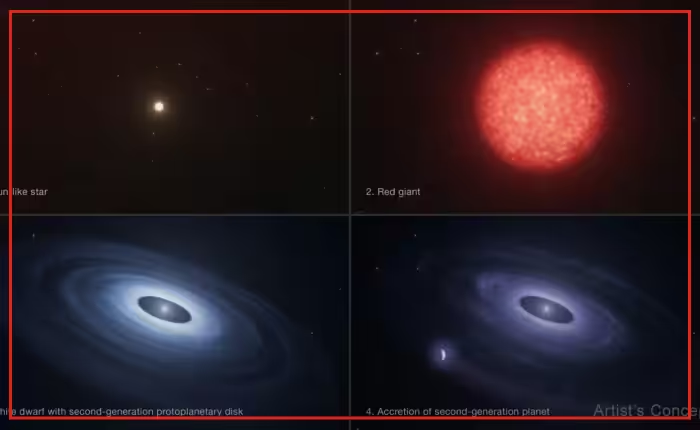
Astronomers tracked a rare world orbiting a dead stellar core, according to a study in Nature Astronomy. The finding reveals how debris cast off by a dying star can coalesce into a new world. The study centers on the remnant star HS 0209+0832.
That star burned through its nuclear fuel. Researchers detected chemical signatures around the object. The evidence points to a newly created world built from expelled debris.
First-generation worlds take shape from material left behind when a host star forms. Most known worlds developed through that early process. This newly identified body formed long after that stage.
Scientists analyzed observation data gathered by the Hubble Telescope. That instrument recorded roughly 100 unidentified chemical features during an initial 1999 observation run. The elements required conditions found only around dying stars.
Astronomers theorize those expelled materials gathered into a giant gas body. The planet measures about the same size as Jupiter. It is rapidly losing its atmosphere.
Scientists believe the world will survive. The body will persist while the core cools. NASA reported the world could remain in a habitable zone for millions of years.
White dwarf stars are the remaining cores of low-mass stars that finished their life cycles. Such remnants cool slowly over vast stretches of cosmic time.
The space telescope continues to supply data for deep space research. The agency tracks long-term planetary evolution across distant star systems.