Redistricting reshuffled 1 in 10 Americans, report finds
A new study found that mid-decade redistricting has changed the U.S. House districts for about one in 10 Americans. About one-fifth of districts have had more than a quarter of their voters replaced compared with the 2024 election cycle, according to the report from Protect Democracy.
The report found that 34.8 million people now live in a different district than they did during the 2024 election. In some districts, more than a quarter of voters are new to the district compared with the last cycle.
Ben Raderstorf, a policy advocate at Protect Democracy and one of the paper’s co-authors, said the changes raise questions about representation.
“If this trend continues, it really brings into question whether or not elected officials are really representing their constituents anymore, or if the voters are being randomly picked by mapmakers to squeeze out partisan advantage,” Raderstorf said.
The redistricting battle began when President Donald Trump urged the Republican-controlled legislature in Texas to redraw its congressional map to help the party. California’s legislature responded with a referendum to tilt its map toward Democrats. Other states followed, and Republicans are positioned to potentially gain nine seats because of redistricting.
Protect Democracy’s report warned that partisan redistricting tactics reduce faith in elections and insulate incumbent lawmakers from public opinion. Both parties may enter what the report called a “doom loop” of more aggressive and frequent redistricting to avoid losing ground.
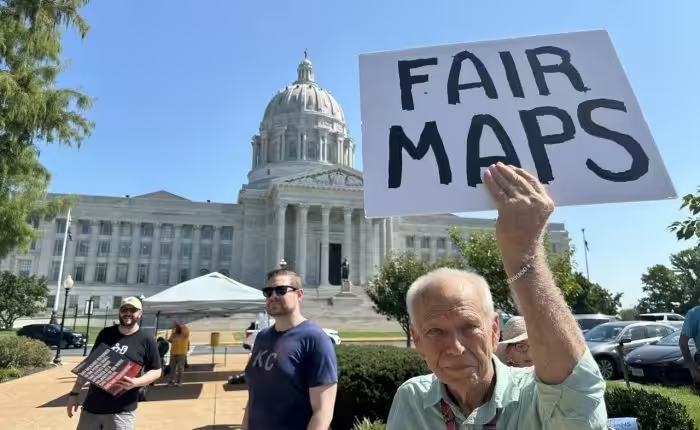
In Missouri, mid-decade redistricting created confusion for voters about which district they live in and which candidates will appear on their November ballot. After conflicting lower court rulings, the U.S. Supreme Court last week blocked new Missouri districts backed by Trump that had been used in the primary, leaving the state to revert to its previous districts for the general election.
The report called for new electoral structures such as proportional representation or a formal party truce on nonpartisan districting plans. Nine states already use nonpartisan commissions to draw district lines, but those provisions have limits. California suspended its nonpartisan maps with a referendum last year in response to Texas’ redistricting measures.
Raderstorf said the trend will worsen without action.
“This is only going to get worse until somebody stops it,” Raderstorf said. “The logic of gerrymandering points inevitably towards maximalist partisan advantage on both sides. There is no off-ramp other than reform. It is the only way to break the cycle.”