Volkswagen Mission Efficiency prototype sets three efficiency records
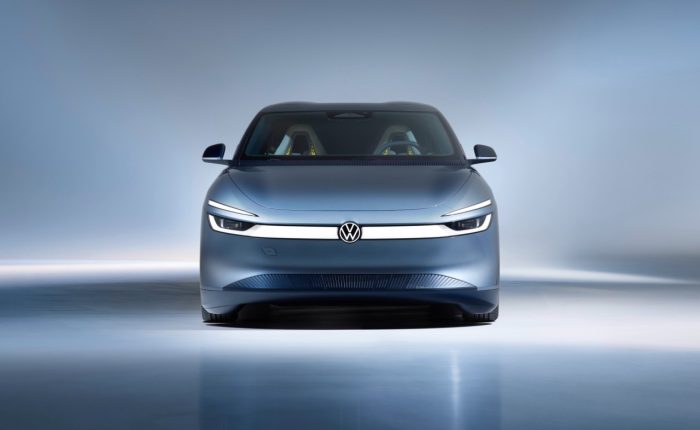
Volkswagen’s Mission Efficiency prototype has set three efficiency records in a near-production electric car class defined by the Record Institute for Germany. The records cover drag, energy use on a controlled run and energy use on a long-distance trip, with Volkswagen pairing the results to production hardware from its MEB+ program.
The headline figure is a drag coefficient of 0.158, paired with a frontal area of 2.08 square meters. Volkswagen also reports 6.48 kWh per 100 kilometers in a constant-speed run at 68 km/h with peripheral electrical loads switched off and no uphill sections, and 6.89 kWh per 100 kilometers, excluding charging losses, on a 1,278.36-kilometer trip from Wolfsburg, Germany, to Vienna, Austria.
The long-distance run matters most for ordinary drivers. Volkswagen says the car traveled from its development center in Wolfsburg through Poznań in Poland and Olmütz in the Czech Republic before reaching Vienna, averaging 67.72 km/h and reaching a top speed of 138 km/h. Including charging losses, the figure was 7.51 kWh per 100 kilometers. The 54.9-kWh net battery was charged once during the journey, and the car arrived with an indicated 164 km of remaining range.
Volkswagen does not claim the car drove nearly 800 miles on a single charge. The trip began with energy already in the battery and included one charging stop. The record category itself is narrower than an overall efficiency title, covering a near-production four-seat EV suitable for everyday use.
The Mission Efficiency prototype uses a 99-kW electric motor and high-voltage battery technology related to the ID. Polo, with the front suspension and hydraulic front brakes also drawn from that program. At the rear, Volkswagen introduced an electromechanical brake developed with technology supplier AUMOVIO, which it says reduces friction losses and supports energy recuperation. The prototype has EU road approval and meets applicable safety, strength and crash requirements.
Continental helped develop a concept tire based on its EcoContact 7. Volkswagen reports a rolling-resistance figure of 4.9 kilograms per tonne, about 25 percent below the threshold for the European Union’s best tire-label efficiency class.
The body itself uses a teardrop-like profile, active cooling-air flaps, a fully covered underbody, covered rear wheels, frameless glass and door handles integrated into the body surface. It is 4,775 mm long and 1,392 mm high. Volkswagen says that above 80 km/h, Mission Efficiency uses more than 30 percent less energy than the standard ID. Polo. At 140 km/h, the prototype requires roughly the same energy as the ID. Polo does at 100 km/h.
The cabin strips out weight in ways that may not survive the transition to a showroom model. A portable Bluetooth speaker replaces a conventional installed audio system, and a “bring your own device” approach allows a smartphone or tablet to substitute for a built-in infotainment display. A 370-watt photovoltaic system is integrated into the glass roof and rear deck, which Volkswagen says supports onboard electrical consumers and could add up to 30 km of real range per day depending on season, location and weather.
Volkswagen chief designer Andreas Mindt connects the project to the XL1, a plug-in hybrid introduced in 2013 that was built around extreme efficiency. Mission Efficiency revisits that philosophy for the battery-electric era, with four seating positions and 481 liters of cargo capacity, though the rear seats are intended for passengers no taller than about 1.60 meters.
“Technology for the masses – not just for the few,” is how Volkswagen CEO Thomas Schäfer described the project’s goal. He said the records were achieved around affordable production technology from the ID. Polo and ID. Cross on the front-wheel-drive MEB+ platform.
Volkswagen also disclosed that software increased the usable battery energy for the record vehicle from 52.0 to 54.9 kWh net, noting that a production car would not normally use the maximum energy content in the same way because battery longevity must be protected.