Gaza City building collapse kills 16 as ceasefire stalls
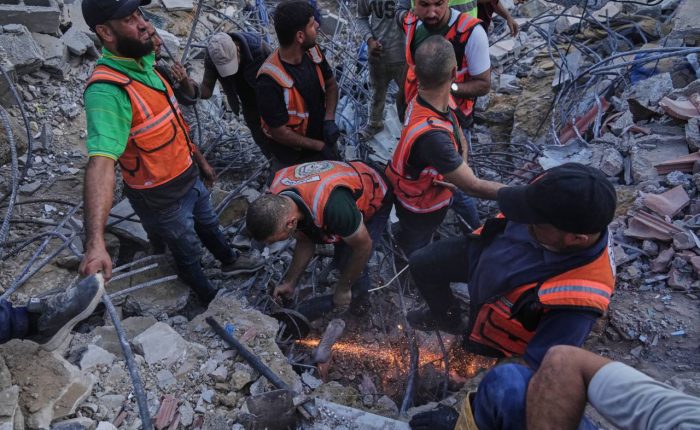
A building housing half a dozen families collapsed in Gaza City overnight into Wednesday, killing sixteen people as they slept. Rescuers dug through rubble for dozens more who had been sheltering inside the structure.
The sixteen dead include at least twelve women and children, according to Zaher al-Wahidi, a spokesperson for the Gaza Health Ministry. The toll was expected to rise as more bodies were recovered from the wreckage.
The building was known to be unstable due to damage from Israeli strikes earlier in the war, according to Gaza’s civil defense. At least six displaced Palestinian families were living in the structure despite knowing it was teetering on the brink of collapse.
“The lack of options and alternatives left them with no other choice,” said Aboud Majdalawi, a rescuer with the force.
All of Gaza’s roughly 2 million people now live in a stretch of land that makes up less than half of the territory. They remain dependent on aid and are surrounded by Israeli troops who carry out strikes or attacks on a near-daily basis.
People searched desperately in the aftermath for loved ones or their remains. A group of men were seen carrying the headless body of a child. Others sat atop a pile of rubble, pulling at flashes of color they believed could be clothing worn by a survivor. All they found were dust-caked blankets wedged in the debris.
There has been no reconstruction work since the ceasefire was agreed to almost a year ago. Israel has said it will not allow any rebuilding until Hamas disarms. The level of destruction has forced Palestinians to choose between crowded tent camps or what’s left of the enclave’s damaged buildings.
Despite an October ceasefire that has reduced fighting in Gaza, Israel has continued to carry out strikes, killing at least 1,375 people since the agreement went into effect, according to local health officials.
The nearly three-year Israel-Hamas war has killed more than 73,789 Palestinians, according to Gaza’s Health Ministry. The ministry, part of the Hamas-run government, maintains detailed records viewed as generally reliable by U.N. agencies and international organizations. It does not distinguish between civilians and militants, but says women and children make up around half of the toll.