Los Alamos National Laboratory helps NASA launch space weather probe
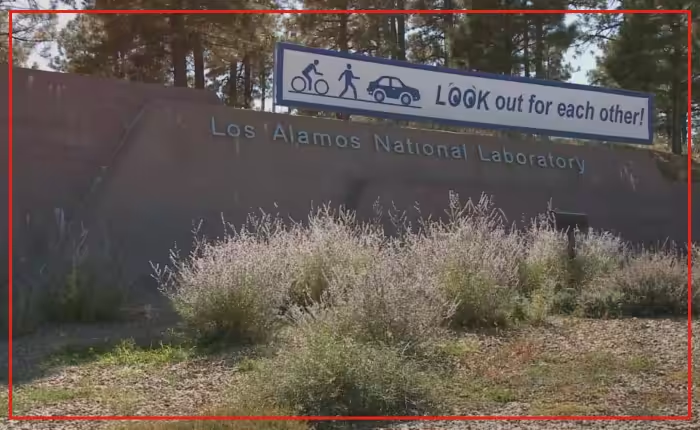
Scientists in Los Alamos sent two research tools into orbit to study conditions in the galaxy. The instruments will track solar winds and help protect vital equipment on Earth. A launch lifted the gear from Cape Canaveral Space Force Station in Florida this week.
The Interstellar Mapping and Acceleration Probe, or IMAP, carries out three missions to track space weather. The spacecraft carries 10 total instruments. Technicians at Los Alamos National Laboratory built two of those devices.
The probe will observe the heliosphere. That protective bubble surrounds the sun and planets. Solar wind particles from the sun inflate that entire bubble.
The two local tools perform distinct observation jobs. Space scientist Herbert Funsten explained the hardware functions.
“One is an electron instrument that samples electrons in the solar wind as it flows by, and the other instrument is going to remotely look at the boundary of the sun’s space environment, and we’re going to be able to see what happens when that solar wind hits that boundary,” Funsten said.
Solar particles create electric fields during space events. Those fields can disrupt GPS signals on Earth. Space scientist Ruth Skoug noted the danger to utility networks.
“These moving particles also create electric fields which can disrupt GPS signals that we depend on for many things and can also couple into our power grid, leading to failures of our grid on Earth,” Skoug said. “So, it’s important that we understand these storms and hopefully be able to predict when they’re coming so that we can make sure our systems are safe.”
Space scientist Dan Reisenfeld pointed out the dual mission of the program.
“Our laboratory, Los Alamos National Laboratory, is dedicated to this endeavor because our involvement in IMAP allows us to innovate designs for future satellites, not only for scientific discoveries but also for national security purposes,” Reisenfeld said.
The probe will travel for four months. It will operate one million miles from Earth toward the sun.
The federal research facility in Los Alamos develops scientific instruments for major flight programs. Teams test these tools before delivery to launch sites. The data returns to ground teams for long-term study.
The satellite now heads toward its observation post.