Jakarta welcomes Indonesia’s first aircraft carrier
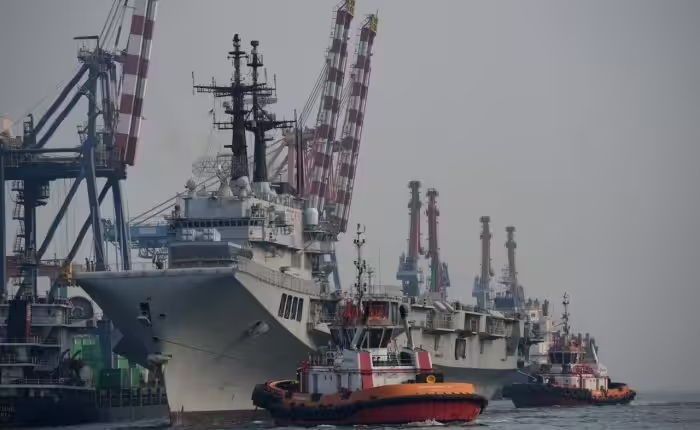
Indonesia welcomed its first aircraft carrier Friday, a 41-year-old former Italian warship that the government says will strengthen the country’s maritime security and disaster response capabilities. The arrival has also fueled debate over the cost of acquiring and operating the aging vessel.
The former ITS Giuseppe Garibaldi, which can carry short takeoff and vertical landing aircraft and helicopters, was welcomed with a military ceremony upon arrival at a naval base in North Jakarta’s Tanjung Priok seaport.
Italy agreed in March to give the carrier, retired in 2024, to Indonesia in a move aimed at boosting Italy’s broader defense engagement with the Southeast Asian country. Italy is seeking deals on submarines and aircraft, and gifting the carrier also saves it the cost of decommissioning the ship.
“We intend to use the ship primarily for military operations other than war, although it can also be deployed for combat missions if necessary,” Indonesian Navy chief Adm. Muhammad Ali told reporters after the ceremony. Ali said the carrier could serve the navy for another 15 to 20 years and could accommodate 14 helicopters or more, depending on their size.
Indonesia will become the second country in Southeast Asia with an aircraft carrier. Thailand’s HTMS Chakri Naruebet was commissioned in 1997 after being procured from Spain along with carrier-capable AV-8S Matador jump jets.
Ali said the carrier will be commissioned into the navy next week as the KRI Sriwijaya, honoring the Srivijaya empire, a maritime kingdom based in Sumatra that became one of Southeast Asia’s dominant naval and trading powers between the seventh and 13th centuries. Previously, the navy had referred to the carrier as KRI Gajah Mada.
Defense development has been one of the top priorities for President Prabowo Subianto’s administration, which has advocated expansion of the military through purchases of submarines, frigates, fighter jets and missiles and pushed for more defense cooperation with various countries.
The Garibaldi acquisition has raised questions about whether Indonesia needs an aircraft carrier at all and whether the government should be spending millions of dollars to refurbish and operate an aging warship.
Indonesia’s Finance Ministry approved $450 million in financing for the aircraft carrier program in 2025. Some lawmakers have warned the overall bill could be far higher. TB Hasanuddin, a member of Parliament’s Commission I, said the cost of retrofitting the carrier alone could reach 16 trillion rupiah, about $900 million.
Unlike major naval powers that use aircraft carriers to launch fighter jets far from home shores, Indonesia views the vessel as a mobile command center and support hub for helicopters, uncrewed aircraft and maritime operations across its thousands of islands.
Speaking during a disaster management meeting early this month, Prabowo said the vessel would help authorities combat forest and peatland fires that regularly blanket parts of Southeast Asia with hazardous haze.
“We will refurbish it and convert it into a carrier for helicopters and drones,” Prabowo said in a video briefing. “This will greatly help our disaster response.”
He also outlined plans to operate drones from the ship and use it as a mobile platform that could be rapidly deployed to help in the event of natural disasters. Monsoon flooding, earthquakes and volcanic activity are common across Indonesia.
Operating a carrier is extremely costly, and experts have questioned whether Indonesia’s leadership has thought through whether one is necessary for the country’s defense or disaster-relief needs.
The acquisition comes as Southeast Asia’s largest economy faces growing fiscal pressures. Prabowo’s government has been funding an ambitious free nutritious meals program and other costly initiatives while economists have warned about slowing growth, weaker state revenue and widening budget constraints, prompting closer scrutiny of major government spending projects.
“The plan to acquire the Garibaldi must be based on genuine operational needs and our ability to operate it, rather than being driven by pride or other considerations,” said Muhammad Fauzan Malufti of the Center for Strategic and International Studies.
He said policymakers must weigh not only the vessel’s acquisition and modernization costs, but also the navy’s ability to sustain its operations, including personnel, maintenance, fuel, weapons systems and supporting infrastructure.
Fauzan said the government should be transparent about those considerations, particularly given the vessel’s age. He cited Thailand’s carrier as a cautionary example, saying it has spent much of its service life in port because of operational and budget constraints.
“The bottom line is that this should not be forced. Otherwise, the benefits could be outweighed by the costs,” Fauzan said. “The money might be better spent on other priorities, such as increasing the number of frigates in the fleet.”
Military analyst Khairul Fahmi of the Institute for Security and Strategic Studies said aircraft carriers are not a priority for Indonesia, which is focused on preventing adversaries from operating freely in the country’s territorial waters.
“Indonesia has a greater need for submarines, frigates and asymmetric weapons systems to protect its maritime sovereignty,” he said.
But Fahmi added that if Indonesia is seeking to position itself as a major maritime nation, “an aircraft carrier can be both a symbol of national power and a multifunctional platform capable of supporting a wide range of military and non-military missions.”