Therapy dogs support students after school shooting in Evergreen
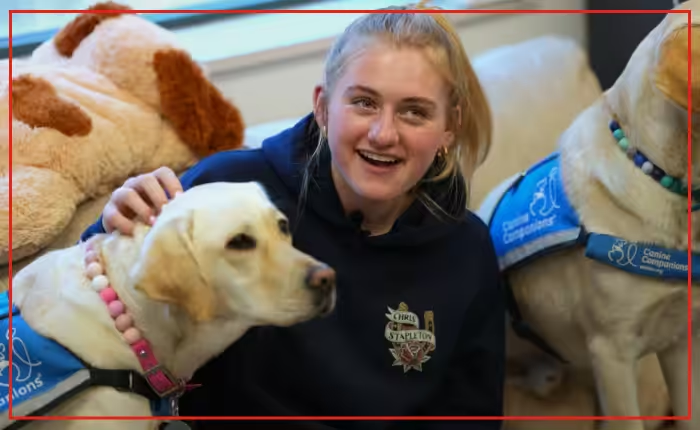
Principal Skyler Artes welcomed two support dogs to Evergreen High School southwest of Denver. The golden Labs help students heal from trauma caused by a campus shooting last year. The animals walk the halls every morning.
The two canines are named Norene and Polenta. They visit classrooms and greet teenagers at the doors. These dogs offer a calm presence across the building.
Junior Fisher Helbraun sees the animals as soon as he arrives on campus.
“Every morning after I get off the bus, I have to say hi to these two. It’s my first thing I do every day,” Helbraun said. “Every single time I see one, I always have a smile on my face. I always get either some puppy kisses or I get some nice pets.”
Norene is a calm, young dog that enjoys affection from people. She started working at the school in March. Polenta is energetic and joined the staff in August.
Canine Companions trained both animals free of charge. The California nonprofit matches assistance dogs with facilities in need. These golden Labs are the first dogs placed in a school following campus gun violence.
Nonprofit provides trained golden Labs
In September 2025, a 16-year-old student opened fire with a revolver during lunch hour. The gunfire wounded two students before the shooter turned the gun on himself. The shooter later died.
Artes sheltered inside the main office with staff members and teenagers. She remained on site until every person safely exited the building.
The violence created deep pain across Evergreen.
“Everybody was devastated, a lot of sorrow, a lot of grief, a lot of uncertainty about how to proceed,” Artes said.
Canine Companions brought dogs to a reunification site right away. Handlers kept bringing animals to Evergreen in the days following the attack. Artes then decided the school needed permanent support animals.
“The fact that they are calm, that they’re generally peaceful and attentive makes them good at providing that ongoing, consistent, stable source of support, affection and quiet when people need it most,” Artes said.
The dogs quickly gained love from the student body. Both dogs wore royal capes on the football field last week. Students crowned them prince and princess at the homecoming game.
Senior Maddie Cornwell seeks out the dogs during her school day.
“The second that I see them in the hallway, or I go out of my way to come see them, it just brightens my day, it makes it so much better,” Cornwell said. “That kind of innocent joy and love that they have to share, they just give it to humans so easily and it just makes you so happy to see them play and run around.”
Handlers complete training for campus dogs
Artes serves as the primary handler for Norene during school hours. Lead counselor Amy Wells handles Polenta during the day. Wells coaches volleyball and brings the dog to team practices.
Both staff members completed handler instruction with the nonprofit group. The organization begins training puppies on dozens of distinct skills. Dogs learn to follow basic commands like sitting and staying.
The animals also learn how to comfort people during distress. Trainers prepare dogs to stay calm in areas that trigger traumatic memories, according to Paige Mazzoni, chief executive of Canine Companions.
“What’s really powerful about dogs in this type of work is that they have a lot of heart, they have high intelligence, they respond very well to people and to forming a partnership, and it’s really the power of the human-canine bond,” Mazzoni said.
Senior Quinn McEvers visits the animals every day between classes. She noted that petting them helps her relax before difficult academic exams.
“Having these dogs in the school is amazing because when we have tests, when there’s a stressful moment, when the weather’s bad, when, honestly, anything puts our mood kind of down, the dogs are there,” McEvers said.
Research indicates school shootings often lead to lower test scores. Evergreen observed the opposite trend among its pupils, Artes said.
“We saw our AP test scores go up,” Artes said. “We also had a 100% graduation rate in a year that was extraordinarily difficult.”
Assistance dog programs place trained working animals with schools and healthcare facilities. These certified canines complete rigorous tasks to support human mental health. Handlers guide the animals through daily interactions in public settings.
Working dogs remain on duty for eight to 10 years before retiring. Artes plans to request replacement animals when Norene and Polenta finish their service in Evergreen.