Abara’s $20M expansion in limbo as El Paso border wall construction begins
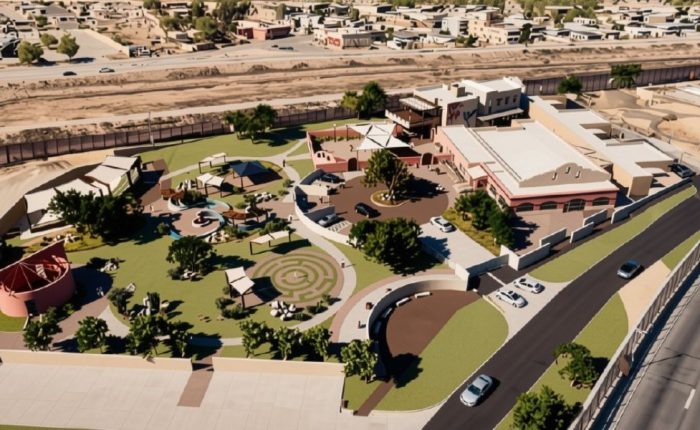
Construction crews have started working along the Rio Grande west of Downtown El Paso on a new secondary border wall near a nonprofit organization. The work has left Abara’s $20 million expansion plans in limbo, with the organization’s property line facing the proposed route of a 30-foot-tall barrier.
Border Report observed crews operating heavy equipment along Paisano Drive near the historic Hart’s Mill area, working close to Abara. The nonprofit conducts humanitarian programs and educational “Border Encounters” on both sides of the U.S.-Mexico border.
U.S. Customs and Border Protection sent Abara a letter on July 24 notifying it about plans to build a 30-foot-tall secondary barrier made of steel bollards with anti-climb features along the edge of the nonprofit’s property. An 18-foot border barrier already stands steps from Abara’s property near the Rio Grande.
Abara Executive Director Sami Di Pasquale told Border Report the CBP letter is vague and leaves the organization with significant unanswered questions about exactly where the new border wall will be located.
“They just said it is at the edge of our property,” Di Pasquale said.
Di Pasquale said the information provided to Abara indicates the wall will run along the edge of the nonprofit’s property. The organization is concerned about whether construction could affect the property and future development plans.
The uncertainty comes as Abara works to raise $20 million to restore and develop the 5.5-acre site into a peace-building center and the “Abara House,” a permanent space envisioned for education, dialogue, community engagement and its Border Encounters program. So far, the nonprofit has raised about $2 million toward the project.
Di Pasquale said he has spoken with border wall contractors working in the area but that they could not provide additional clarity about what is planned near Abara.
“They don’t know either what exactly they are going to do,” Di Pasquale said.
Di Pasquale told Border Report Abara has watched border security infrastructure steadily expand around the property over the years.
“There have been additions of razor wire at the bottom of the fence, down by the river; now razor wire at the top of the fence,” he said.
The nonprofit sits near the historic Hart’s Mill area and a site associated with the 1598 expedition of Don Juan de Oñate and El Camino Real de Tierra Adentro, the historic route that connected central Mexico with settlements farther north.
Martha Vera, honorary consul of Spain in El Paso and president of the Hispanos Foundation, told Border Report that Oñate crossed the Rio Grande in the area on May 4, 1598. She said the crossing and subsequent settlement helped shape communities and families that remain in the Borderland today.
Vera said the crossing site is connected to ongoing efforts involving El Camino Real de Tierra Adentro. The Mexican portion of the route is already recognized as a UNESCO World Heritage Site, and advocates have sought an extension that would incorporate historically significant portions of the route in the United States.
For Vera, another border barrier raises questions about whether an already difficult-to-access historic landscape could become even more isolated.
“It’s very sad for me, and I think it’s sad for our history and our legacy because we need to protect and preserve our monuments,” Vera said.
Vera also raised concerns about what additional border infrastructure could mean for wildlife, particularly animals and birds that historically followed migratory routes across what is now the international boundary.
Vera said efforts are underway to develop a spiritual and historical route following paths used by Franciscan missionaries from the Ciudad Juárez area through present-day San Elizario and El Paso and north toward Santa Fe.
“We cannot erase our history,” Vera told Border Report. “If we don’t know who we are, somebody else is going to tell you who you are.”
Others who use Abara’s property question why another barrier is necessary in an area where a border wall already exists.
“There’s already a wall right here,” El Paso artist Krysten Duran told Border Report. “You can leave Abara and you can actually put your hands on the border wall.”
Duran said she worries about the disruption another major construction project could bring to the area.
El Paso resident Marco Raposso said the proposed wall conflicts symbolically with Abara’s mission. He said the word “Abara” is connected to the concept of crossing in a positive sense, crossing to encounter and unite with others.
“So to put a wall here, it is in direct opposition to what the project is all about,” Raposso said. “It’s already bad that we have one wall. To put another one, it doesn’t make sense.”
The proposed secondary barrier comes amid a much larger expansion of border infrastructure across the U.S. Border Patrol’s El Paso Sector. CBP has awarded three major contracts in Texas and New Mexico totaling approximately $1.58 billion.
- The largest, valued at about $850.4 million, covers work in Texas and calls for approximately 42 miles of new primary border wall, nearly 6 miles of new secondary wall and about 46 miles of associated system infrastructure.
- A second contract worth approximately $578.9 million covers work in New Mexico, including about 23 miles of new primary border wall and approximately 81 miles of system attributes.
- A third contract, worth approximately $155.1 million, covers the Santa Teresa, New Mexico, area and calls for replacing approximately 7 miles of existing barrier and installing about 22 miles of system attributes.
CBP has not confirmed to Border Report which of the three contracts includes the proposed construction near Abara.
The July 24 notice leaves Abara with another fundamental question: exactly where will the new 30-foot barrier go? Di Pasquale said the organization understands the barrier will run along the edge of Abara’s property, but the letter does not provide enough detail for the nonprofit to determine how construction could affect its plans for Abara House.
CBP’s notice said the agency sought public input on the environment, cultural resources, commerce and quality of life. The public comment period ended Aug. 25.
Border Report asked CBP and the Department of Homeland Security when construction near Abara is expected to begin, which contract includes that section of the border, the precise location of the secondary barrier, and which other property owners or organizations received notices and whether they were provided any feedback. Border Report also asked whether the project will require access to or otherwise affect Abara’s property.
CBP has not responded to those questions.